
New analysis: when ChatGPT, Gemini and Google name providers at all, measured with real search queries from Austria.Read, in German →
Atziry
Industry · SaaS and technology

Is your software named when teams ask AI?

Before a team tests software, it often asks ChatGPT which tools are worth a look. We measure for which use cases and comparisons your product gets named and build the pages that answer those questions.

Schematic illustration, not an original screenshot.
AronDrawn golden eagle with an orange scarf and a monocle

I see when your product is missing.

What does AI visibility mean for SaaS companies?

In plain wordsAI names software it can clearly assign to a use case: what the tool is for, which team size, what it costs and what it integrates with. A list of features alone rarely answers those questions.

Drawn golden eagle with an orange scarf and a monocle

AI cannot place the product

A team looks for a tool to sort support requests. AI names others, although your product covers exactly this workflow.

Drawn owl with an orange scarf and a notebook

Features instead of guidance

A tech lead compares two developer tools. The vendor page lists features but does not say which team they fit.

Drawn marmot with an orange scarf and binoculars

Informed, but no click

A buyer learns from the answer which kinds of software exist and only clicks when she needs prices or integrations.

What we see in 18,000 software searches

Searches about software, tools and apps, without product or brand names.

18,000searches about software, tools and apps in our analysis
56%of them have four words or more, often a whole use case
1.9%click-through rate, almost the same for long and short searches
4 in 100searches start as a question, such as "which software …"

Decision makers describe their problem in full sentences, such as capturing invoices automatically. AI looks for tools that fit. The ones named are those with the use case, integrations and prices clearly on their own site.

Source: our own analysis of 2.38 million searches without brand names from over 300 websites, mostly from Austria, June 2025 to October 2026. Only searches that clearly belong to this industry are counted. Provider analysis

Which questions lead to names

Software is often chosen through comparisons. There ChatGPT names names less often than in direct provider searches, but the shortlist is already formed in the answer.

AspectExample from your industryChatGPT names providers
Provider search"which software offers the best automated invoice processing with intelligent receipt recognition?"85%
Price question"fleet software cost"55%
Comparison"audit proof archiving software comparison"39%
Knowledge question"what is an ai tool"22%

Source of percentages: our provider analysis with 873 searches, October 2026, all industries. The example questions come from our analyses and show how users in this industry ask, translated from German.

The questions decision makers really ask

From our analyses: this is how decision makers ask when they look for offers like yours, translated from German. Next to them: what your website needs for them.

Source: our own analyses of search queries, mostly from Austria, June 2025 to October 2026. Only questions that came up several times independently, without company, brand or personal names.

How we work

From the customer's problem to the page that solves it.

  1. 01
    FiniDrawn fox with an orange scarf reading a map

    Collect use cases

    How do decision makers describe their problem? From search data, sales calls and support requests.

    Result: use cases by demand

  2. 02
    MurmelDrawn marmot with an orange scarf and binoculars

    Measure comparisons

    Which tools does AI name for "best software for" and in direct comparisons, and with which arguments?

    Result: your place in comparison answers

  3. 03
    UlliDrawn owl with an orange scarf and a notebook

    One page per use case

    With integrations, team size, prices and data protection, plus honest comparison pages.

    Result: pages for the selection phase

  4. 04
    AronDrawn golden eagle with an orange scarf and a monocle

    Connect to the pipeline

    We track mentions, trials and demos from those visits separately.

    Result: see what reaches the pipeline

Which vendors benefit

Depending on the product, different people ask different questions. We measure the ones that fit your audience.

B2B SaaS

Business software

Long selection processes with many people involved, each asking different questions.

DevTools

Developer tools

Technical questions about languages, APIs and setup.

Vertical

Industry software

Questions about software for a specific industry, often with few names in the answers.

Data and AI

Data and AI platforms

Questions about data protection, hosting and use in the EU.

Atziry platform

See how AI
talks about you

The platform shows per use case which tools AI names, with which arguments and where your product is missing.
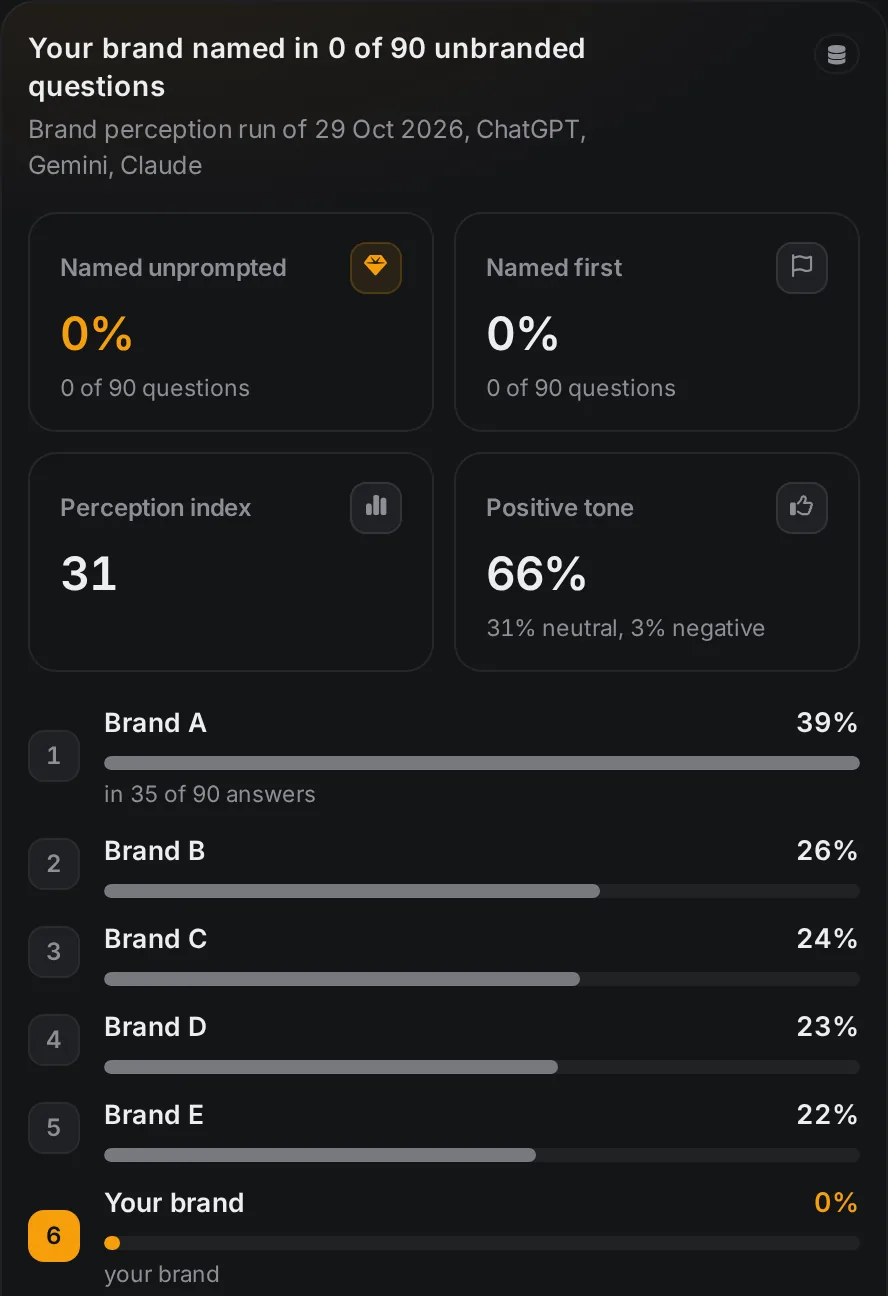
Brand perception analysis: unprompted mentions, tone and brands named instead of yours
A real analysis across ChatGPT, Gemini and Claude. Brands replaced.
  • Per use casewe measure your customers' problems, not your product name
  • Comparisonswho is named next to you and why
  • Traceablefor every suggestion, the data it is based on

What you get

AronDrawn golden eagle with an orange scarf and a monocle

Measure first, then act.

  • Use casessorted by demand
  • Comparison measurementwho gets named in selection questions
  • Pages per use casewith integrations, prices and data protection
  • Comparison pagesfactual and with sources
  • Pipeline viewtrials and demos from those visits

FAQ: AI visibility for SaaS companiesIncluding the questions for which AI cites other providers today.

How do decision makers really ask about software?
Often as a long, precise sentence with requirements: function, integration with existing systems and data protection, for example "which invoice processing platform integrates with our accounting and erp systems?". Pages per use case and per integration answer exactly that.
How does our software get into AI recommendations?
When AI can clearly assign your product to a use case and finds good sources about it: pages per use case, honest comparisons, mentions on trade sites. We first measure for which questions you get named today.
AI visibility audit
Which pages should we build first?
Pages per use case and comparisons that answer a selection question directly. In our data test, a citation was most strongly linked to whether a page answers the question directly.
GEO data test
Do we need review platforms?
They can help, because AI often finds sources there. We have no own evidence that they are the strongest lever for software. We check which sources actually get cited for your questions.
AI comparisons describe our product with wrong features. What helps?
Wrong details usually come from outdated or conflicting sources, such as old pricing pages, comparison portals or review sites. What helps is a current page per feature and per comparison with clear details, corrected entries on the portals the AI cites, and a follow-up measurement of whether the new details are picked up.
How do we see this in sales?
Mentions per question and system in the platform, plus visitors and inquiries from AI sources under their own tag. That way you can follow what reaches the pipeline.
Does it work in German and English?
Yes. Many software questions are asked in English. We measure and write separately for each language.
What does it cost?
It depends on the number of use cases, markets and languages. A product with a few clear use cases is measured faster than a whole suite. After the first call you get a fixed quote.

For which use cases
is your product missing?

In the first call we ask a few typical selection questions live and show which tools get named today. Free, no obligation, 30 minutes.

Your contact: Aredi Dragusha, aredi@atziry.com